KPRC 2′s senior reporter Phil Archer is retiring this week after nearly 45 years of covering the news in Houston.
We’d like our viewers to help wish him well. You can send in your messages to Phil using the form below. We might even use your message in one of our newscasts.
Thanks for helping us wish Phil a happy retirement.
This week, the Senate is expected to take up and pass President Joe Biden’s massive $1.9 trillion coronavirus relief package, the fifth major piece of legislation to be considered since the pandemic began about a year ago.
The bill includes $1,400 payments for most adultsandfor each of their dependents. That means households will receive much larger payments than Congress delivered in the Coronavirus Aid, Relief and Economic Security (CARES) Act in March 2020, which paid $1,200 per adult but only $500 per child.
A family of four earning less than $150,000 stands to receive $5,600 in direct payments from the bill, compared to $3,400 from the CARES Act. (Two-earner households earning above $200,000 will get nothing.)
The average CARES rebate for tax filers in the middle 20% of earners was $1,642, according to the conservative Tax Foundation, while middle-earning households will get $2,431 on average from the new bill.
Democrats conceived of the forthcoming payments as a follow-up to the smaller $600 checks Congress sent as part of a compromise bill in December, since Biden and then-Democratic Senate candidates in Georgia had promised they would support $2,000 checks.
The package also includes big expansions of tax credits that will send another $3,600 per child under the age of 6 to the poorest households, though it’s unclear if the cash will arrive as a lump sum during next year’s tax season or as advance monthly payments starting this summer. Experts say the money would put a huge dent in child poverty.
Already, the $600 payments and extra unemployment benefits from the December bill pushed poverty down in January,according to researchers.
A family of four with $100,000 of income would have received $9,500 in rebate checks and tax credits in 2020, but it also stands to receive $22,600 this year from the December bill, plus the additional payments and tax credits in the new bill, according to Marc Goldwein, an economist with the Committee for a Responsible Federal Budget.
The new bill would also tack on $400 per week in added federal unemployment benefits, which will start to expire March 14 if Congress fails to act, plus hundreds of billions of dollars for schools, restaurants and coronavirus vaccine distribution.
A $15 minimum wage hike is unlikely to be included in the bill, however. The Senate parliamentarian ruled last week that lawmakers can’t increase the minimum wage through the budget reconciliation process, the legislative maneuver that would allow Democrats to pass legislation with a simple majority. Progressives are calling on Democrats to overrule the parliamentarian ― but doing so would require 51 votes, an unlikely scenario.
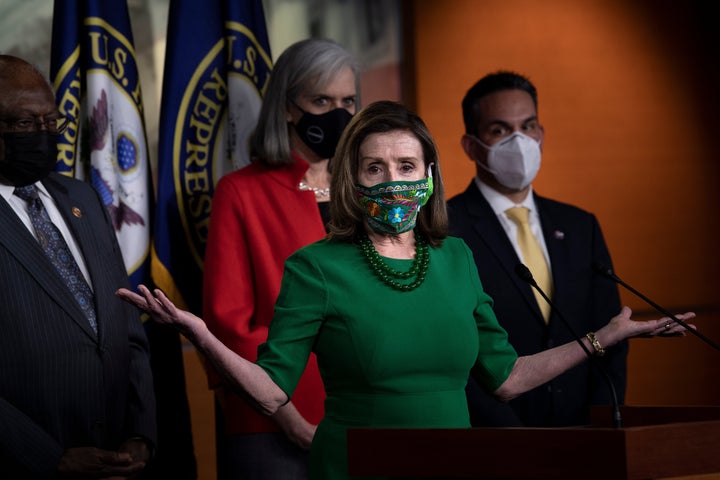
BRENDAN SMIALOWSKI via Getty Images
House Speaker Nancy Pelosi (D-Calif.) speaks during a press conference with other House Democratic leaders about COVID-19 financial relief and minimum wage on Capitol Hill on Feb. 26 in Washington, DC.
White House press secretary Jen Psaki said last week that Biden “respects the parliamentarian’s decision and the Senate’s process,” signaling that the administration isn’t girding for a messy fight that could delay passage of the bill.
It’s possible that lawmakers eventually agree to a more modest increase to the minimum wage, which currently stands at $7.25 and has not been raised for more than a decade. Sen. Joe Manchin (D-W.Va.), a key moderate, is supportive of an $11 minimum wage. Several Republicans have also floated minimum wage increases.
The final details of the $1.9 trillion package will be hashed out later this week when senators are given an opportunity to offer amendments during a marathon session in the chamber. Democrats will need to stay completely united, a major challenge in an evenly divided 50-50 Senate.
So far, no Republicans are expected to support the bill, which passed last week in the Democratic-controlled House on a party-line vote. GOP attempts to brand the legislation as a payoff to progressives full of wasteful spending haven’t had much success. Polls showwide supportfor Biden’s plan, including among a majority of Republican voters.
“We should listen to our voters. And the majority of the American people, the overwhelming majority of the American people and of both parties, are urging us to act,” Sen. Chris Coons (D-Del.) told CNN on Sunday. “We’re moving ahead with a bill that probably will get no Republican votes in the Senate, but will have broad Republican support in the country.”
Republican lawmakers acknowledge that Biden’s plan contains popular elements, but they argue that other items need to be trimmed substantially. In particular, they object to sending hundreds of billions in aid to schools and state and local governments.
“Very few people look at all the specifics. I think what they understand is there’s more money ― and we do need more money to help people ― but they look a little more deeply and realize the bill needs to be improved. And that’s what I’m trying to do,” Sen. Mitt Romney (R-Utah) told HuffPost when asked about the polling data.
Once the Senate passes the bill, it will go back to the House for another vote before being sent to Biden’s desk for his signature. Democrats are racing to pass the bill in a few weeks to prevent the lapse in added unemployment benefits and boost vaccine distribution for millions of Americans.
Calling all HuffPost superfans!
Sign up for membership to become a founding member and help shape HuffPost's next chapter
PORTSMOUTH, Va. (WAVY) — 10 On Your Side has done numerous stories on people having problems with unemployment, but lately we’re getting complaints about a particular kind. They’re causing concern especially this time of the year when people are filing their taxes.
At 71, Willie Carter of Chesapeake got an unwelcome surprise a few weeks ago in the mail. It was a tax statement from the Virginia Employment Commission, form 1099-G, saying he received $17,688 in unemployment benefits last year.
“I’m retired and I have no need for unemployment,” Carter said in a Monday morning interview. He saw our previous reports on people getting similar mistaken tax documents.
It’s the largest mistaken benefits amount we’ve seen so far and amounts to more than just an inconvenience, although for Carter, that too has been considerable.
“I started calling the [VEC], even sending out documentation to them – and they just put you from one phone to another. You never get in contact with anybody you can speak to and I never got a response and I just finally decided to call [10 On Your Side].”
The money is subject to federal tax.
“I’m ready to file my taxes, and I don’t want to file them knowing that this is hanging over my head and probably get hit later with a fraudulent tax form or something like that,” Carter said.
He has filed a fraud claim and got a confirmation number. We will send his info to the VEC’s fraud department. If you have a problem with unemployment, contact us at reportit@wavy.com.
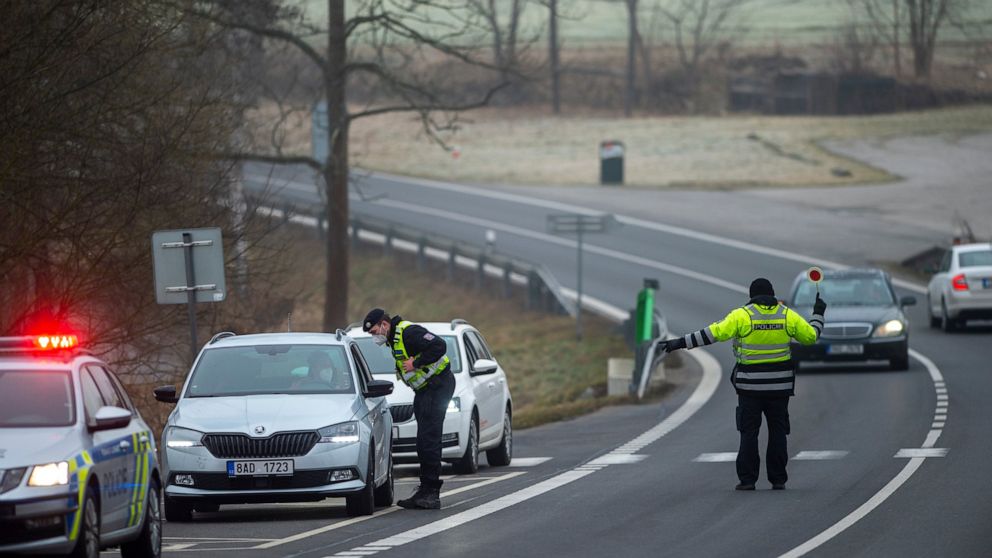
Czech police and military forces have set up 500 checkpoints across the country to enforce new strict limits on free movement
ByKAREL JANICEK Associated Press
March 1, 2021, 8:14 PM
• 3 min read
PRAGUE -- Police and military forces in the Czech Republic set up 500 checkpoints across the country as one of the European Union's hardest-hit nations marked the first anniversary of its coronavirus outbreak on Monday by significantly limiting free movement.
Some 30,000 officers were involved in an unprecedented operation to enforce a tight new restriction that bans people from traveling to other counties unless they go to work or have to take care of relatives.
It's part of a series of measures that took effect Monday as the Central European nation seeks to slow down the spread of a highly contagious virus variant first found in Britain.
Prime Minister Andrej Babis said the measure’s goal was to prevent the country's hospitals from collapsing under the stress of caring for COVID-19 patients.
Amid a surge of infections from the U.K. variant, of the 7,049 COVID-19 patients in Czech hospitals on Sunday, 1,507 needed intensive care. Both the numbers are close to the records set earlier last week.
Since the Czech Republic registered the first three people infected with coronavirus on March 1 last year, the nation of 10.7 million has see over 1.24 million confirmed cases with 20,469 deaths.
The seven-day rolling average of daily new cases has risen from 70.75 new cases per 100,000 people on Feb. 14 to 109.82 per 100,000 people on Sunday, the worst per-capita rate in the world, according to Johns Hopkins University.
As of Monday, people in the Czech Republic who go out for exercise should not leave their municipality. Nursery schools and schools for children with disabilities were also closed while only stores selling essential goods remain open.
Experts, however, say the measures don’t go far enough to stop the virus.
“I consider the most important measures those that haven’t been applied,” biochemist Jan Trnka told the Czech Public radio. “That is to limit contacts at work, especially in the industry.”
The government also approved a plan to require mandatory mass testing of employees. It will start in the companies with more than 250 workers on Wednesday followed by those with at least 50 employees on Friday.
Industry and Trade Minister Karel Havlicek said around 10,000 firms and companies are expected to test 2.1 million workers in the next two weeks.
Havlicek has previously rejected calls to close at least some plants and factories as “unrealistic.”
Meanwhile, the country is speeding up its vaccination program with general practitioners joining inoculation centers. Over 650,000 vaccine doses have been given out. Babis said 1 million vaccine shots were expected to arrive through an EU program in March and another 2.6 million in April.
In a sign of solidarity, three states in neighboring Germany have sent the Czech Republic 15,000 dozes of the AstraZeneca vaccine to try to control contagion at the border.
Babis and pro-Russian President Milos Zeman also said they would use Russia’s Sputnik V vaccine even if it’s not approved by the European Medicines Agency.
Trader watches his screen during the recent bond retreat. (Photo by David Dee Delgado/Getty Images)
Getty Images
All of a sudden, it seems, the long placid bond market has lurched into action. Prices have dropped and, as in the way of bond math, yields have risen. The price retreat began late last October and has picked up momentum in this new year. Much of what seems to have upset bond investors has been evident for quite a while. But some sources of concern are relatively new, in particular the spending plans of the Biden administration. The combination of existing and new concerns is hitting markets with what might be described as a four-punch combination.
The accounting to date is far from as devastating as the major bond retreats of the past, but it is noteworthy, nonetheless. Since late last October, the yield on 10-year treasury bonds has risen from 0.8% to 1.4%. The accompanying price erosion has overwhelmed the low yield originally offered on the bonds to give bond buyers a net loss on the investment. Yields on less volatile 5-year treasury notes have risen during this time from 0.4% to 0.75%, also imposing a net loss on the investment. It is not just dollar markets that have seen such action. In Britain, yields on 10-year government bonds have risen from 0.3% to near 0.8%. Australian 10-year government bond yields have risen to about 1.7% from under 0.8% just four months ago. German government bond yields remain negative but have risen some 25 basis points toward positive during this time. All these moves have created losses for bond investors.
Throwing thee first of these four punches was the untenable state of bond markets toward the end of 2020. With short-term interest rates driven down to about zero and actually negative in some places and active bond buying on financial markets by the Federal Reserve (Fed) and other central banks, bond yields had already fallen below the rate of inflation. Without some major policy push to keep driving rates and yields down (and so prices up) bond holding was already a losing proposition in real terms. Meanwhile, the Fed and other central banks showed little likelihood or adding still more support than they already were providing markets. In other words, bonds were an unattractive investment unless the unlikely happened. To be sure, less credit worthy bonds continued to offer yields above the rate of inflation, but the risk they carried recommended other investments above bond buying. In such an environment, anything in the least bit discouraging could tip the flow of monies away from bonds.
The second punch has come out of investors’ understanding that the Fed’s ongoing liquidity support always cut two ways. It sustains demand for financial assets, including bonds, but longer-term and more fundamentally, a surplus of liquidity also always contains the threat of an accelerating inflation that would erode the real value of the interest earned on bonds. While the pandemic raged, investors thought little about inflation, especially since the economy had enjoyed a long stretch of low inflation before the virus arrived, but with vaccinations spreading and a full or almost-full economic re-opening on the horizon, these once faint secondary inflation concerns began to grow in bond investors’ calculations.
To be sure, Fed Chairman Jay Powell assured all and sundry at his recent Congressional testimony that inflation was not a concern. Still, bond investors looked at consensus economic expectations for 4.7% real growth in 2021 and 3.6% in 2022 and could not share Powell’s optimism. They could see that such growth exceeded historic trends in the U.S. economy by a wide margin, implying that the economy would return rapidly to full employment and accordingly develop a potential for economic overheating and inflation problems. The Fed’s clear intention to continue pouring liquidity on the economy in the interim only added to such concerns.
MORE FOR YOU
Concrete evidence of inflationary pressure has thrown a third punch. At the consumer level, inflation does indeed remain quiescent, as Chairman Powell described. The Labor Department’s consumer price index indicates a mere 1.4% general rise in prices during the 12-months ended this past January, the most recent period for which data are available. The broadest price gauge, the deflator for the entire gross domestic product (GDP), also shows little inflation. It has risen a mere 1.2% during the four quarters of 2020. But more sensitive price measures offer less encouragement. Commodity prices have risen sharply during the past six months or so. Copper prices, for example. have jumped some 43% during this time. Other industrial commodities have shown a similar acceleration. Oil prices are up 44%. The latest look at producer prices offered by the Labor Department also offers cause for concern. This gauge of what producers pay for their inputs rose 1.7% during the twelve months, approaching the 2.0% commonly used by policy makers as a preferred target. In January it surged 1.7%, some 22% at an annualized rate. No one expects it to continue at this pace, but the jump is ominous, nonetheless.
The fourth punch, the one most recent, has come out of the deteriorating picture of federal finances. Concerns on this front have grown especially since the election. There can be little doubt that federal finances had taken a bad turn long before November’s vote. Tax cuts in 2017 had already enlarged budget deficits greatly and spending to bolster the economy during the pandemic had added to the flow of red ink, which official sources projected to reach $2.3 trillion in 2021, some 10.3% of GDP and well above historic norms of about 3% of GDP. Then late last year the newly elected President Biden immediately promised an additional $1.9 trillion in spending, bringing the 2021 deficit estimates to over $4 trillion, almost 18% of GDP.
Especially since the economy is expected to surge with the planned re-opening, many economists, even Democratic economists like Larry Somers, have warned that this additional spending is excessive and could lead to economic overheating. The inflation threat is implied. Considering that the new White House is also talking about spending on a version of the Green New Deal, the prospect of over stimulus and an overheated and inflationary economy have become real. If this were not enough to frighten bond investors, the flood tide of red ink implies that tremendous federal borrowing will create a huge supply of new debt and an inevitable downward pressure on bond prices.
Back in the 1990s, bond investors, having suffered great inflation-induced losses during the 1970s and early 1980s, were extremely sensitive to any economic development or government policy that threatened to bring back the inflation hell. On the slightest hint of economic overheating or excessive monetary ease and especially federal budget deficits, bond investors sold out and created sometimes violent market setbacks. The action of what came to be called the “bond vigilantes” disciplined economic policy making. Today’s memories of the damage inflation can cause are neither as recent nor acute enough to recreate the market responses of those times. Nor will the recent rise in yields continue uninterrupted. But recent bond market action is reminiscent of those days of acute sensitivity and worthy of note, by investors and policy makers alike.
PRAGUE — Police and military forces in the Czech Republic set up 500 checkpoints across the country as one of the European Union's hardest-hit nations marked the first anniversary of its coronavirus outbreak on Monday by significantly limiting free movement.
Some 30,000 officers were involved in an unprecedented operation to enforce a tight new restriction that bans people from traveling to other counties unless they go to work or have to take care of relatives.
It's part of a series of measures that took effect Monday as the Central European nation seeks to slow down the spread of a highly contagious virus variant first found in Britain.
Prime Minister Andrej Babis said the measure's goal was to prevent the country's hospitals from collapsing under the stress of caring for COVID-19 patients.
Amid a surge of infections from the U.K. variant, of the 7,049 COVID-19 patients in Czech hospitals on Sunday, 1,507 needed intensive care. Both the numbers are close to the records set earlier last week.
Since the Czech Republic registered the first three people infected with coronavirus on March 1 last year, the nation of 10.7 million has see over 1.24 million confirmed cases with 20,469 deaths.
The seven-day rolling average of daily new cases has risen from 70.75 new cases per 100,000 people on Feb. 14 to 109.82 per 100,000 people on Sunday, the worst per-capita rate in the world, according to Johns Hopkins University.
As of Monday, people in the Czech Republic who go out for exercise should not leave their municipality. Nursery schools and schools for children with disabilities were also closed while only stores selling essential goods remain open.
Experts, however, say the measures don't go far enough to stop the virus.
"I consider the most important measures those that haven't been applied," biochemist Jan Trnka told the Czech Public radio. "That is to limit contacts at work, especially in the industry."
Only on Monday did the Czech government start to require mass testing of employees on a voluntary basis. That was expected to become mandatory Friday in companies with more than 250 workers.
Industry and Trade Minister Karel Havlicek has rejected calls to close at least some plants and factories as "unrealistic."
Meanwhile, the country is speeding up its vaccination program with general practitioners joining inoculation centers. Over 650,000 vaccine doses have been given out. Babis said 1 million vaccine shots were expected to arrive through an EU program in March and another 2.6 million in April.
In a sign of solidarity, three states in neighboring Germany have sent the Czech Republic 15,000 dozes of the AstraZeneca vaccine to try to control contagion at the border.
Babis and pro-Russian President Milos Zeman also said they would use Russia's Sputnik V vaccine even if it's not approved by the European Medicines Agency.
___
Follow all of AP's pandemic coverage at https://apnews.com/hub/coronavirus-pandemic, https://apnews.com/hub/coronavirus-vaccine and https://apnews.com/UnderstandingtheOutbreak
INDIANAPOLIS — On March 10 FOX59 and CBS4 will host a town hall, IN Focus: Path out of the Pandemic.
We want your questions for Indiana’s congressional delegation about the next steps for stimulus plans, mask mandates and the path to economic recovery.
The town hall airs at 7 p.m. on March 10 on FOX59 and CBS4.
Starting at 8 p.m, we’ll continue the conversation with a 30-minute digital special on the stations’ respective websites to discuss other matters facing Congress.
Have a question for Indiana’s congressional delegation? Ask using the form below:
March 01, 2021 at 08:32PM
https://fox59.com/news/coronavirus/send-us-your-questions-for-indianas-congressional-delegation-for-our-special-town-hall-in-focus-path-out-of-the-pandemic/
Send us your questions for Indiana’s congressional delegation for our special town hall: ‘IN Focus: Path out of the Pandemic’ - Fox 59
:strip_exif(true):strip_icc(true):no_upscale(true):quality(65)/cloudfront-us-east-1.images.arcpublishing.com/gmg/4WJRLLMKBVBUBA4EE2BP4IPWYA.png)